

¿Cómo limpiar y mantener las tarimas coextruidas de calidad comercial?


Autor
Con años de experiencia en materiales de construcción para exteriores, me especializo en tecnologías avanzadas de compuestos de madera y plástico (WPC). Mi objetivo es ayudar a arquitectos, contratistas y gerentes de proyecto a comprender las complejidades de las soluciones modernas para terrazas. Al conectar la ingeniería estructural con el diseño sostenible, comparto conocimientos prácticos para garantizar que sus proyectos exteriores alcancen la máxima durabilidad y el mejor retorno de la inversión posible.
Marie R. Winters


Tabla de contenido: Protocolo de mantenimiento
- 1. La ciencia del escudo: por qué las manchas no pueden penetrarlo
- 2. Saneamiento rutinario: Parámetros de lavado a presión
- 3. Matriz de respuesta ante derrames comerciales
- 4. Operaciones de invierno: Remoción de nieve y mitigación del hielo
- 5. La lista negra: productos químicos y herramientas que anulan las garantías
- 6. Reducción de los gastos operativos a largo plazo para los administradores de instalaciones.
La fase de entrega de cualquier proyecto comercial al aire libre es crucial. Cuando un contratista termina de instalar un patio de hostelería de alto tránsito, un paseo marítimo municipal o una terraza residencial multifamiliar, el equipo de administración de la propiedad asume de inmediato la responsabilidad de su mantenimiento. Tradicionalmente, heredar una terraza de madera implicaba heredar una enorme responsabilidad operativa, que requería un presupuesto específico para el decapado químico, el lijado y el teñido.
La transición a Tarimas coextruidas de calidad comercial Este sistema redefine por completo los protocolos estándar de gestión de instalaciones. Gracias a que el núcleo estructural está totalmente encapsulado en una capa de polímero impermeable, el mantenimiento requerido se reduce de la conservación estructural a la limpieza básica de la superficie.
Este documento técnico constituye el protocolo definitivo de mantenimiento posterior a la instalación. Describe los procedimientos operativos exactos, las limitaciones de los equipos y las respuestas químicas necesarias para que las superficies compuestas recubiertas funcionen a la perfección durante décadas de uso comercial intensivo.
1. La ciencia del escudo: por qué las manchas no pueden penetrarlo
Los responsables de las instalaciones deben comprender primero la física del material que mantienen. La madera natural y los compuestos de primera generación (sin recubrimiento) poseen una estructura de celdas abiertas. Cuando un líquido cae sobre estas superficies, la acción capilar lo introduce profundamente en las fibras en cuestión de minutos. Una vez que el aceite o el tanino penetran la estructura celular, limpiar la superficie resulta inútil; la mancha es permanente hasta que se lija mecánicamente la capa superior.
La tecnología de coextrusión neutraliza la acción capilar. La capa superior de polímero especialmente diseñada forma una barrera 100 % cerrada y no porosa. Cuando un cliente derrama un plato de comida grasienta o un pájaro deja excrementos en la tabla, la materia orgánica queda completamente adherida a la tensión superficial microscópica de la capa superior. No puede unirse químicamente al núcleo subyacente. Por lo tanto, la limpieza consiste simplemente en romper la tensión superficial y retirar los residuos.
2. Saneamiento rutinario: Parámetros de lavado a presión
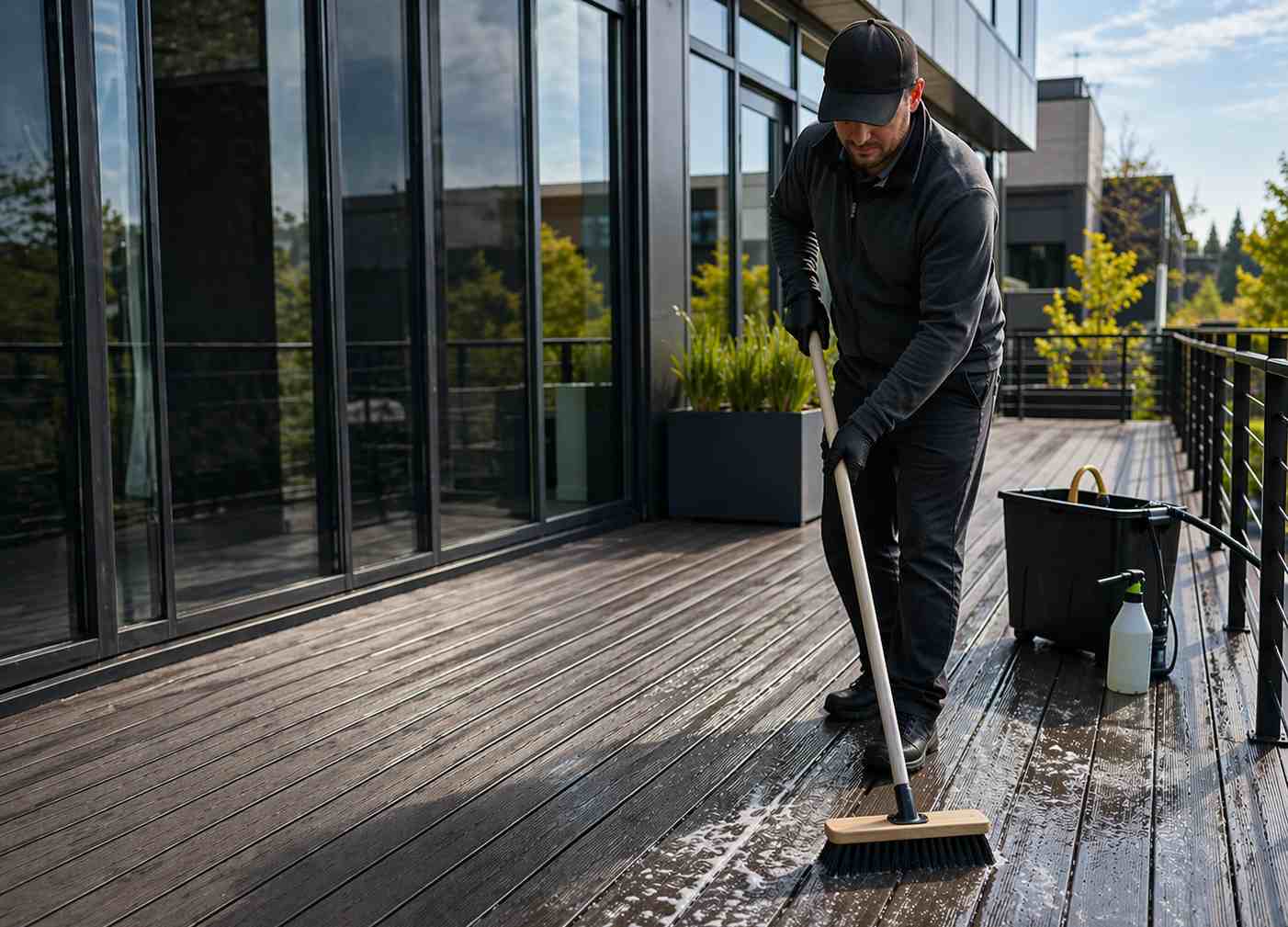
Para evitar la acumulación de suciedad ambiental habitual, como polvo, polen y contaminación atmosférica, es necesario un lavado regular para mantener la nitidez estética de la veta de la madera en relieve. Si bien una manguera de jardín estándar y un cepillo de nailon de cerdas suaves son suficientes para uso residencial, en espacios comerciales se utilizan hidrolimpiadoras para mayor eficiencia.
El uso de una hidrolavadora en compuestos recubiertos es totalmente seguro y recomendable, siempre que el personal de mantenimiento de jardines cumpla estrictamente con los siguientes parámetros para evitar el grabado microscópico del escudo de polímero:
| Parámetros del equipo | Directrices comerciales estrictas |
|---|---|
| Presión máxima (PSI) | No exceda las 1500 PSI (libras por pulgada cuadrada). |
| Punta de la boquilla / Ángulo de pulverización | Utilice una boquilla de abanico amplia (con un ángulo mínimo de 30 a 40 grados). Nunca utilice un chorro puntual de 0 grados. |
| Distancia de funcionamiento | Mantenga la boquilla a una distancia mínima de 25 a 30 cm (10 a 12 pulgadas) de la superficie de la cubierta en todo momento. |
| Técnica de lavado | Rocíe siempre en la dirección de la veta longitudinal de la madera para eliminar los residuos de la textura en relieve. |
3. Matriz de respuesta ante derrames comerciales
Las áreas de comedor al aire libre, los bares junto a la piscina y los parques públicos sufren derrames químicos y orgánicos graves a diario. La principal ventaja de un Pavimento exterior de WPC sin mantenimiento La ventaja del sistema es que rara vez se requiere una remediación de emergencia; la mancha no se fijará si se deja durante la noche.
Cuando los equipos de las instalaciones aborden estos derrames específicos, deberán utilizar las siguientes respuestas químicas dirigidas:
| Tipo de contaminante | Solución y protocolo de limpieza aprobados |
|---|---|
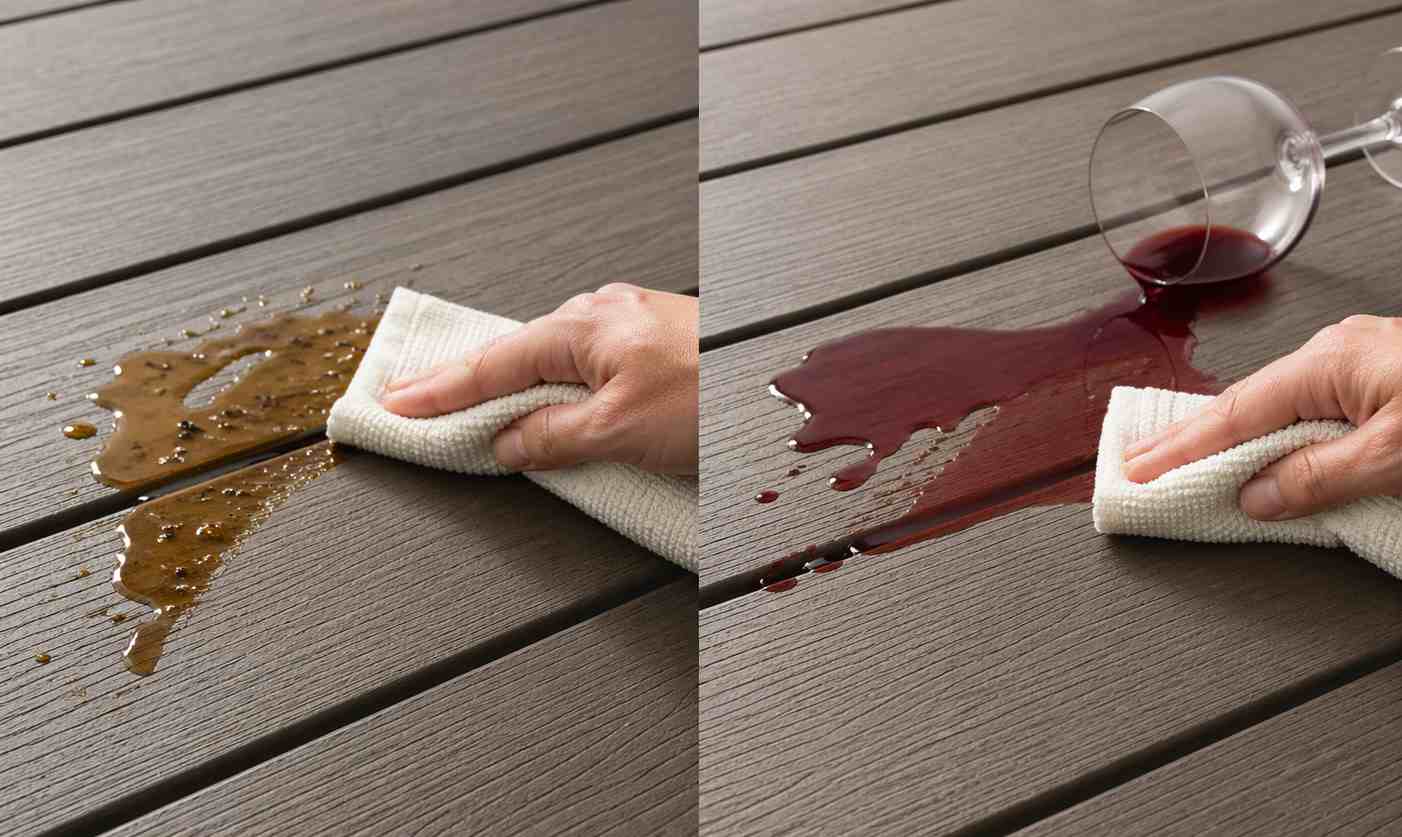
| Grasa de alimentos y aceite para barbacoa | Aplique detergente líquido para lavavajillas (desengrasante) directamente sobre la mancha. Deje actuar durante 5 minutos para emulsionar los lípidos, frote con un cepillo de nailon y enjuague con agua caliente. |
| Vino, bayas y taninos | Jabón suave diluido y agua tibia. Para la materia orgánica seca, un cepillo de cerdas suaves eliminará inmediatamente los azúcares del grano de polímero. |
| Manchas de agua dura y depósitos minerales | Suele aparecer cerca de piscinas. Aplique una solución de vinagre blanco y agua al 50%. El ácido acético suave disuelve los depósitos de calcio sin dañar la capa protectora. Enjuague bien. |
| Tiza de construcción y marcas | Evite usar tiza de construcción roja o azul (contienen tintes permanentes). Para las rozaduras de los zapatos, use una goma de borrar o lave con agua caliente y jabón. |
4. Operaciones de invierno: Remoción de nieve y mitigación del hielo
En estaciones de esquí o zonas urbanas del norte, el mantenimiento invernal es crucial para la durabilidad de los materiales. Las cubiertas de polímero coextruido están diseñadas para soportar ciclos de congelación y descongelación a temperaturas bajo cero sin fracturarse. Sin embargo, el error humano durante la retirada de la nieve es la principal causa de daños en la superficie.
- Productos para derretir hielo aprobados: Los responsables de las instalaciones deben utilizar cloruro de calcio o sal gruesa para derretir el hielo de forma segura. Una vez que suban las temperaturas, el residuo mineral blanco resultante debe enjuagarse de la superficie para recuperar la visibilidad.
- Logística para la remoción de nieve: Nunca No utilice palas con filo metálico ni picos de hielo afilados. La hoja de acero inevitablemente dañará la protección de polímero, anulando la garantía de fábrica. Los equipos de mantenimiento deben usar palas para nieve con filo de plástico y siempre palear en paralelo a la veta de la tabla.
5. La lista negra: productos químicos y herramientas que anulan las garantías
Si bien los escudos de polímero son químicamente inertes a la mayoría de las sustancias orgánicas, pueden verse comprometidos por disolventes industriales altamente corrosivos o por una fuerza mecánica agresiva. Los gerentes de abastecimiento que confían en un Fabricante de composites con revestimiento de primera calidad Cabe esperar décadas de rendimiento, pero esas garantías están supeditadas a evitar lo siguiente:
- Hipoclorito de sodio (lejía): No se debe permitir que la lejía de alta concentración o los cloruro agresivos para piscinas se sequen y se fijen en la superficie bajo la luz ultravioleta intensa, ya que esto puede acelerar la degradación de los polímeros.
- Disolventes industriales: La acetona, los disolventes de pintura y el tolueno fundirán químicamente la capa protectora de HDPE al entrar en contacto con ellos.
- Abrasivos mecánicos: Jamás se deben usar papel de lija, lana de acero ni cepillos de cerdas metálicas gruesas. A diferencia de la madera maciza, no se puede lijar un arañazo profundo en un tablero compuesto sin dañar permanentemente la capa protectora.
6. Reducción de los gastos operativos a largo plazo para los administradores de instalaciones.
La decisión de especificar materiales coextruidos avanzados se reduce, en última instancia, a un cálculo de gastos operativos (OPEX). Al seguir los protocolos de saneamiento simplificados descritos anteriormente, los administradores de propiedades comerciales eliminan la necesidad de contratistas químicos especializados, equipos de lijado pesados y los elevados costos laborales asociados al tratamiento de la madera tradicional.
Los arquitectos y promotores inmobiliarios ofrecen a sus clientes un activo de alta rentabilidad al utilizar la tecnología de extrusión adecuada. La superficie se mantiene impecable, se minimizan los riesgos estructurales y el presupuesto anual de mantenimiento se reduce al coste del agua, el jabón y la mano de obra básica para el cuidado del terreno.
- Cómo calcular las cantidades de tarimas de WPC para proyectos grandes: cobertura de tablas, desperdicio y accesorios.
- Tarimas de WPC para terrazas en azoteas: Planificación de cargas, drenaje y riesgos de impermeabilización
- ¿Qué documentos técnicos debería solicitar a un fabricante de revestimientos de pared de WPC?
- Cómo mantener la uniformidad del color en el revestimiento de paredes de WPC en proyectos de gran envergadura.
- Cómo calcular las cantidades de revestimiento de pared de WPC: cobertura de paneles, desperdicio de corte y accesorios.
- Revestimiento exterior de WPC para la renovación de edificios: Cómo comprobar los sustratos, las fijaciones y la ventilación.
- Tarimas de WPC para hoteles y complejos turísticos: Cómo elegir los materiales para áreas exteriores
- Tarimas de WPC para proyectos comerciales: Cómo especificar tablas para tráfico y clima