

Marine WPC Decking: How Co-Extrusion Improves Performance in Coastal and Waterfront Applications


Autor
Con años de experiencia en materiales de construcción para exteriores, me especializo en tecnologías avanzadas de compuestos de madera y plástico (WPC). Mi objetivo es ayudar a arquitectos, contratistas y gerentes de proyecto a comprender las complejidades de las soluciones modernas para terrazas. Al conectar la ingeniería estructural con el diseño sostenible, comparto conocimientos prácticos para garantizar que sus proyectos exteriores alcancen la máxima durabilidad y el mejor retorno de la inversión posible.
Marie R. Winters


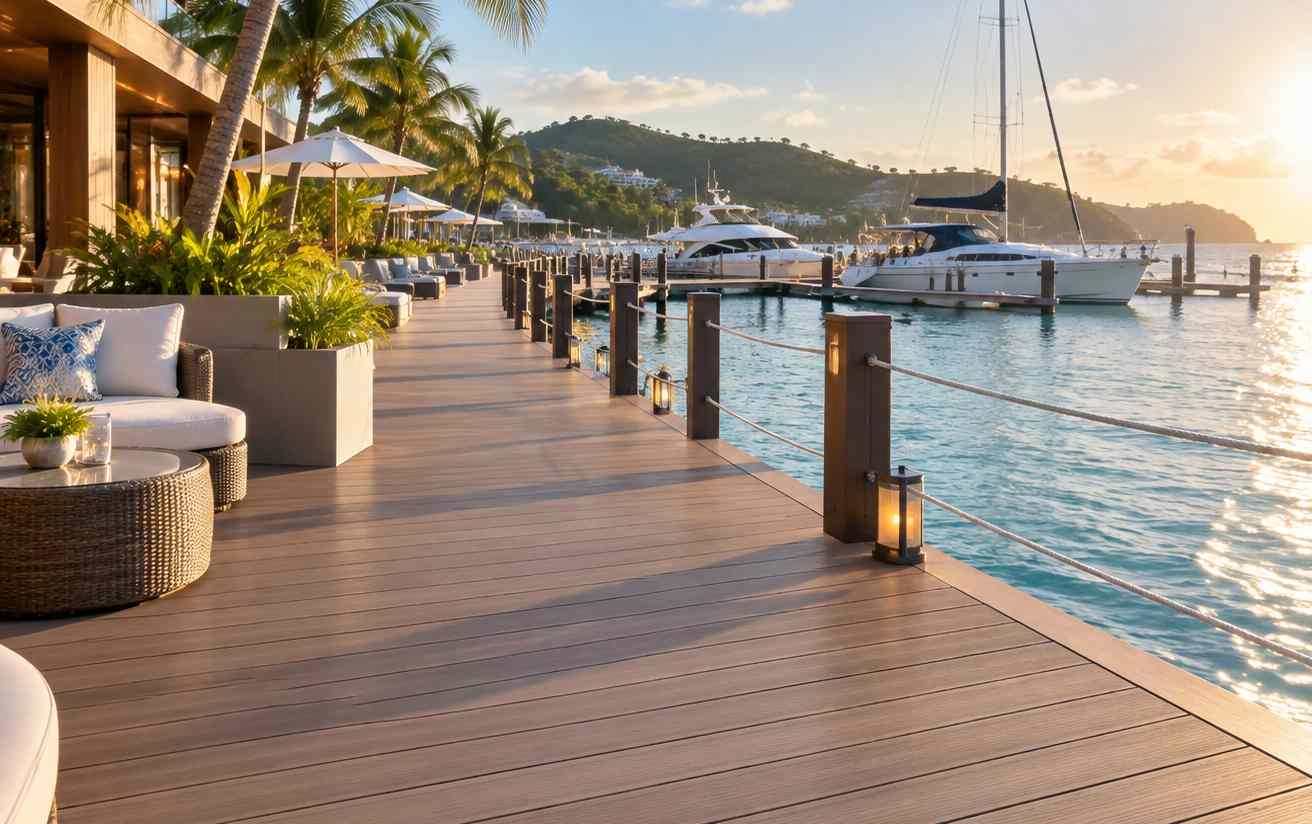
Coastal decking is exposed to conditions that are difficult to reproduce in a conventional outdoor project. Salt spray, high humidity, standing water, strong sunlight and repeated wet-dry cycles can all accelerate material deterioration. On a waterfront walkway, marina, resort deck or seaside restaurant, the decking system must also withstand continuous pedestrian traffic while maintaining a stable and safe surface.
This is why material selection for marine applications should go beyond comparing colors, surface textures and initial price. The more important questions are how the decking handles moisture, how the protective layer performs under UV exposure, how the fasteners resist corrosion, and whether the complete installation system is designed for a marine environment.
Co-extruded WPC decking is increasingly used for these applications because its protective polymer layer creates an additional barrier between the composite core and the surrounding environment. However, the quality of the cap layer, the core formulation, board profile and installation details still determine the actual performance of the finished system.
Why Coastal Conditions Are Harder on Decking
A deck located several kilometers inland may mainly deal with rain and sunlight. A waterfront installation can experience several stress factors at the same time.
| Environmental Factor | Effect on Decking | What Buyers Should Evaluate |
|---|---|---|
| Salt spray | Can accelerate corrosion of exposed metal components | Protective surface and corrosion-resistant fasteners |
| High humidity | Creates prolonged moisture exposure | Moisture resistance and drainage design |
| UV radiation | Can cause fading and surface aging | UV stability and color-retention performance |
| Standing water | Increases continuous wet exposure | Surface design, drainage and substructure ventilation |
| Temperature cycling | Causes repeated thermal expansion and contraction | Expansion gaps and installation method |
| Heavy traffic | Increases surface wear and structural loading | Profile design, span and load capacity |
The important point is that these factors do not operate independently. For example, a board may have good moisture resistance, but poor drainage underneath the deck can still create an unfavorable installation environment. Similarly, a durable decking board cannot compensate for fasteners that are poorly suited to salt exposure.
How Co-Extrusion Creates an Additional Protection Layer
Traditional WPC decking uses a composite material throughout the board. Co-extruded WPC uses a different structure: the WPC core provides the main body of the board while a polymer outer layer is formed over the core during extrusion.
This outer layer is important in coastal applications because the surface is the part of the board directly exposed to water, UV radiation, stains and repeated cleaning.
The objective is not simply to make the board waterproof. A well-designed cap layer can also reduce direct exposure of the WPC core to environmental conditions that contribute to surface degradation.
For buyers comparing different products, it is therefore useful to ask how the cap layer is manufactured rather than accepting “capped” or “co-extruded” as sufficient evidence of performance.
| Feature | What It Does | Why It Matters Near Water |
|---|---|---|
| Protective polymer shell | Separates the core from direct environmental exposure | Reduces surface exposure to moisture and contaminants |
| UV-stable formulation | Improves resistance to sunlight-related fading | Important for open waterfront areas |
| Textured surface | Creates a more functional walking surface | Useful where rain and splashing are frequent |
| Stable WPC core | Provides the structural body of the board | Supports long-term outdoor use |
Saltwater Resistance Is More Than a Deck Board Specification
When a project is described as “marine grade,” buyers should look beyond the decking board itself. The complete installation contains boards, clips, screws, joists, substructure components and drainage paths. Every exposed component needs to be considered.
For example, a high-quality composite board can remain visually stable while ordinary steel fasteners begin to corrode. As corrosion progresses, fastener heads can stain the surface, lose mechanical integrity or complicate future maintenance.
For coastal projects, the procurement specification should therefore identify the required fastening material. Stainless steel fasteners designed for exterior or marine exposure are generally more appropriate than generic hardware for projects with continuous salt exposure.
ECO Deck's WPC co-extruded outdoor flooring specifies a salt-resistant polymer shell and a marine-grade stainless-steel fastening system. The product information also states that the system has been tested under continuous salt-spray exposure equivalent to 20 years of coastal conditions. For a commercial buyer, this type of documented information is more useful than simply describing a product as “marine grade.”
UV Exposure Becomes More Important Near the Coast
Waterfront environments often combine two conditions that can accelerate visible weathering: strong sunlight and reflected light from water surfaces.
For hotels, resorts and public waterfront spaces, color stability can have a commercial impact. A deck that becomes noticeably different in color after several seasons may affect the appearance of the entire outdoor area, particularly when large areas are installed in continuous runs.
Co-extrusion can help by placing a UV-resistant polymer layer at the exposed surface. However, buyers should distinguish between a general UV-resistance claim and actual performance information.
Useful questions include:
- What UV exposure testing has been performed?
- Is the color stabilized through the cap layer or the entire material?
- What color-change information is available after accelerated testing?
- Does the warranty cover excessive fading?
- Are replacement boards from future production runs expected to match the original color?
For distributors, these questions are especially important because coastal projects may require replacement boards several years after the original installation. Consistent color production can become a practical issue when maintaining a large resort, marina or commercial property.
Wet-Dry Cycling: The Overlooked Marine Exposure
Marine decking does not remain continuously submerged. In many applications, the more common condition is repeated wetting and drying.
Rain, sea spray, cleaning, tides and occasional flooding can expose the surface to water, followed by drying under sunlight and wind. This cycle can repeat hundreds or thousands of times over the service life of an installation.
That makes dimensional stability and moisture management important parts of the specification.
| Condition | Potential Risk | Design Response |
|---|---|---|
| Repeated wetting | Persistent surface moisture | Use moisture-resistant decking and adequate drainage |
| Rapid drying | Thermal and dimensional movement | Follow specified expansion allowances |
| Water trapped below boards | Poor ventilation and slower drying | Maintain adequate air circulation |
| Long board runs | Accumulated thermal movement | Follow project-specific installation spacing |
This is one reason installation guidance should be treated as part of the product specification rather than as a separate construction detail.
Drainage Can Be as Important as the Material
A marine decking system needs somewhere for water to go. Even a highly water-resistant board can perform poorly if the substructure prevents rapid drainage.
Before installation, contractors should review the slope, joist arrangement, ventilation, board gaps and access beneath the deck. Areas that remain permanently damp are more difficult to inspect and maintain.
For elevated boardwalks and waterfront terraces, the objective should be to allow rain and splash water to leave the surface quickly while keeping sufficient airflow beneath the boards.
This also makes regular inspection easier. Commercial operators should be able to check the substructure, fasteners and drainage paths without dismantling large sections of the deck.
Choosing the Right WPC Profile for Waterfront Projects
Marine exposure does not automatically mean that every project needs the same board profile.
A private seaside terrace, hotel pool deck and public marina walkway can have very different structural requirements. Profile selection should therefore consider both environmental exposure and expected traffic.
| Application | Primary Environmental Concern | Key Product Considerations |
|---|---|---|
| Seaside residential deck | Salt spray and UV | Weather resistance, appearance and maintenance |
| Resort pool deck | Water, chemicals and heavy pedestrian traffic | Surface safety, moisture resistance and durability |
| Waterfront restaurant | Food stains, cleaning and traffic | Surface resistance and easy maintenance |
| Marina walkway | Saltwater and continuous traffic | Marine fasteners, load performance and drainage |
| Commercial boardwalk | UV, weather and high pedestrian loads | Structural performance, span and long-term maintenance |
For projects where structural performance is also important, co-extruded weather-resistant WPC flooring provides a useful reference point for evaluating board dimensions, reinforced core construction, load capacity and available span information.
What Should Be Included in a Marine WPC Specification?
A professional project specification should give the contractor and buyer enough information to compare suppliers on more than price.
| Specification Category | Information to Request |
|---|---|
| Material | Core composition and cap-layer material |
| Board profile | Dimensions, cross-section and weight per meter |
| Moisture resistance | Water absorption or relevant test information |
| UV performance | Accelerated weathering or UV test data |
| Marine exposure | Salt-spray or equivalent environmental testing |
| Structural performance | Load rating, span recommendations and test reports |
| Fasteners | Material grade and recommended fastening system |
| Installation | Joist spacing, expansion gaps and drainage requirements |
| Warranty | Coverage period and environmental limitations |
This information allows an architect, contractor or distributor to compare products using the same criteria. It also reduces the risk of selecting a decking system based only on a broad marketing statement such as “waterproof,” “weatherproof” or “marine grade.”
How Buyers Can Compare Marine WPC Suppliers
When requesting quotations, ask each supplier to provide the same basic documentation. This creates a more useful comparison than looking only at price per square meter.
- Product technical data sheet
- Profile cross-section drawing
- Recommended joist spacing
- Load or structural test documentation
- UV and weathering information
- Salt-spray or marine exposure data where available
- Fastener specifications
- Installation instructions
- Warranty terms
- Production lead time and customized-length options
For larger projects, buyers should also request samples before approving the complete order. A physical sample can be used to evaluate surface texture, color consistency, cap-layer appearance, dimensional accuracy and compatibility with the proposed fastening system.
When Co-Extruded WPC Makes Sense for Marine Projects
Co-extrusion is particularly relevant when a project combines several demanding conditions: continuous outdoor exposure, salt or high humidity, strong UV radiation, frequent cleaning and a high expectation for appearance retention.
It does not eliminate the need for correct structural design or installation. Instead, it adds another layer of material protection that can be valuable in environments where the exposed surface is continuously challenged by moisture and sunlight.
For heavy-use marine applications, co-extruded durable waterproof WPC decking can be evaluated alongside other profiles based on the project's required load capacity, board dimensions, span, surface requirements and environmental exposure.
The key is to specify the complete system rather than the board alone. A successful waterfront decking project depends on the interaction between the composite core, protective cap, profile geometry, support structure, fastening hardware, drainage and installation practices.
For contractors and distributors comparing marine WPC products, this approach also makes supplier evaluation more transparent. Instead of asking only “How much does the decking cost?”, the more useful question is whether the proposed system has the material performance, structural data and installation support required for the actual coastal environment.
- Cómo el revestimiento de pared de WPC estriado realza los exteriores comerciales y residenciales
- ¿Por qué el WPC es el mejor material para casas costeras y terrazas junto a la piscina?
- Análisis del costo del ciclo de vida de las tarimas de WPC: precio inicial, instalación, mantenimiento y valor a largo plazo.
- Cómo instalar tarimas de WPC para proyectos exteriores: Guía paso a paso
- Paneles de pared WPC para proyectos de interior y exterior: tipos, ventajas, aplicaciones y guía de compra.
- Tarimas de WPC coextruidas: Beneficios, rendimiento, coste y guía de compra B2B.
- Ideas modernas de diseño de vallas de WPC para privacidad y proyectos al aire libre.
- ¿Cómo elegir una valla de WPC impermeable para proyectos al aire libre?